
Table of Contents
Home support vs home care: why the wording matters
If you’re an older adult who wants to stay independent, or an adult child trying to help a parent from nearby (or from a distance), the terms can get confusing fast. People say “home care” when they really mean “a bit of help around the house.” Others use “home support” but aren’t sure what it covers.
In plain language, home support services are non-medical, practical help at home that makes day-to-day living easier and safer without providing personal or clinical care. When someone asks about home support services for seniors GTA, they’re often looking for exactly this kind of help: reliable support with routines, the household, and companionship.
Home support services for seniors are non-medical, practical services that help someone live well at home by supporting daily routines, the home, and social connection.
What “home support” means (and how it relates to “home care”)
The phrase home care is used in different ways. In some conversations, it’s a broad umbrella term that includes everything from housekeeping to clinical support. In other contexts, “home care” implies personal or medical care specifically.
To keep things clear, this article uses these terms in a specific way:
Home support services: Practical, non-medical help with the home and everyday routines.
In-home support: Another common term for the same category—support provided in the person’s home.
Non-medical home support: A clarifier that means the same kind of help, with clear boundaries around what is not provided.
In other words, home support services, in-home support, and non-medical home support all refer to the same category of assistance: help that makes life at home more manageable, without crossing into personal or clinical care.
This distinction matters because it helps you choose the right provider, set expectations, and reduce stress for everyone involved—especially when you’re coordinating support for a parent in Toronto or the GTA.
Who home support is for (and when it may not be the right fit)
Home support is often a good fit when someone is mostly independent but could use steady, practical help to keep life running smoothly.
Who benefits most
– Seniors who are capable and want to keep control of their day-to-day life
– Adult children who want consistent eyes-on support and companionship for a parent
– People who feel overwhelmed by chores, errands, or meal routines
– Families who want a calmer, safer home environment through simple routines
– Anyone who is socially isolated and would benefit from regular, friendly company
When another type of care may be more appropriate
– When hands-on personal care is required (beyond household and routine support)
– When clinical or medical services are needed
– When safety needs can’t be met through non-medical support alone
– When a regulated healthcare professional is required for the situation
This isn’t about “more” or “less” care. It’s about the right match so the person at home gets what they actually need.
Clear boundaries: what home support includes (and what it does not)
Clear boundaries protect seniors, families, and providers. They also make planning easier because everyone knows what to expect.
What home support services typically include
Many home support services providers focus on practical, non-medical assistance such as:
– Light housekeeping
– Laundry
– Simple meal prep + kitchen tidy
– Grocery shopping / errands
– Companionship
– Appointment escort
– Light organizing / decluttering
– Medication reminders (reminders only)
See what living made easy offer here
What home support services do not include
Home support services do not replace personal care or medical care. They do not include hands-on personal care tasks or clinical services.
Below is a simple way to compare the categories.
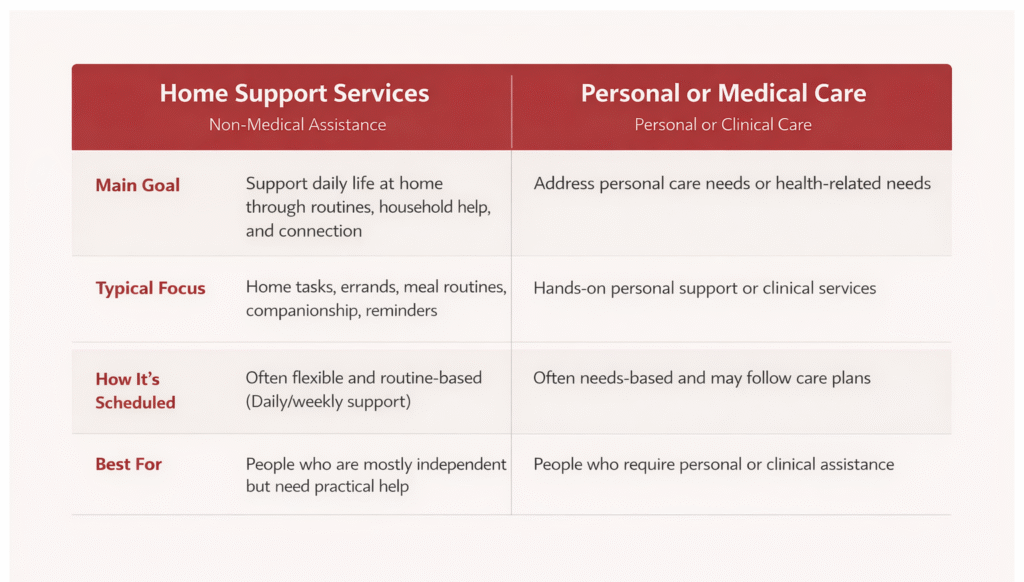
If you’re unsure which category fits, a helpful question is: “Are we looking for household and routine support, or do we need personal/clinical care?” That single distinction usually clarifies the next step.
Practical guidance: how to choose the right support (without overcomplicating it)
When families search for home support services for seniors GTA, it’s often after a small change has become a bigger pattern—missed meals, a cluttered kitchen, fewer outings, or growing loneliness. Planning early tends to keep choices broader and stress lower.
A short checklist to guide your decision
Use this quick checklist before you book calls or schedule a first visit:
– Write down the top 3 pain points (for example: meals, laundry, errands, loneliness)
– Decide what days/times matter most (mornings, evenings, weekends)
– Clarify boundaries in writing (what help is wanted, and what is not)
– Ask how schedules, cancellations, and continuity are handled
– Confirm the person’s preferences (conversation level, food likes/dislikes, routines)
– Identify any household “stress points” (stairs, clutter zones, busy entryway)
– Choose one small goal for the first two weeks (like regular groceries + meal prep)
A good plan is usually simple. Consistency beats intensity—especially when you’re supporting aging at home over the long term.
How Living Made Easy can help in Toronto/GTA
Living Made Easy provides home support services and in-home support for seniors and families across Toronto & the GTA, with a focus on practical, non-medical help that supports daily routines at home.
Support can include light housekeeping, laundry, simple meal prep + kitchen tidy, grocery shopping / errands, companionship, appointment escort (logistics support only), light organizing / decluttering, and medication reminders (reminders only). To learn more and discuss fit, you can start with LivingMadeEasy through an introductory conversation.
A calm next step
Getting help at home is not an all-or-nothing decision. Many families start small, see what reduces stress, and adjust from there.
If you’re in Toronto/GTA and want to explore non-medical home support, book a free intro call at livingmadeeasy.ca.
FAQs:
1) What is the difference between home support and home care?
Home support is defined as non-medical help with household tasks, routines, and companionship, while home care is often used to mean personal or medical care in the home.
2) What do home support services for seniors include?
Home support services are defined as practical help like light housekeeping, laundry, simple meal prep + kitchen tidy, errands, companionship, appointment escort (logistics only), light organizing, and medication reminders.
3) Is home support the same as personal care?
Home support is defined as non-medical assistance and is not the same as hands-on personal care or clinical services.
4) How do I know what kind of in-home support my parent needs?
In-home support needs are defined by what is hardest to manage day-to-day (meals, chores, errands, isolation), and a short trial schedule often clarifies the right level of help.
5) If I can not afford any home care services for my mom what is the solution?
If you can not afford any home care services you may qualify for free Ontario health at home services. you can contact OHAH via there website or you can call 310-2222 seven (7) days a week, 365 days a year.