
Table of Contents
Aging at home is a hope many seniors share, and it is often a hope their adult children carry, too. You want your parents to stay in familiar surroundings, keep their routines, and feel like themselves. At the same time, you may be juggling work, kids, and your own household, while trying to make sure the day-to-day basics are handled.
If you are looking into aging at home support Toronto, it helps to step back and look at what support can mean in real life. Not everything requires medical care. Often, it is the practical things, meals, laundry, clutter, errands, and simple companionship, that make home feel manageable and calm.
This guide focuses on non-medical, practical home support in Ontario. It is meant to help you think clearly, plan gently, and choose help that fits your family’s values.
What “aging at home” means in Ontario
Aging at home, sometimes called aging in place, means continuing to live in your own home as your needs change over time. In Ontario, this can look different for every household.
For one person, it may mean a bit of help with groceries and keeping the kitchen tidy. For another, it might be consistent companionship and an extra set of hands to keep routines on track. For many families, it starts small and grows slowly, based on how life feels week to week.
Aging at home works best when support is proactive, not reactive. When the basics are handled, it is easier to preserve energy for what matters, relationships, hobbies, and a sense of control.
The role of home support services, practical, non-medical help
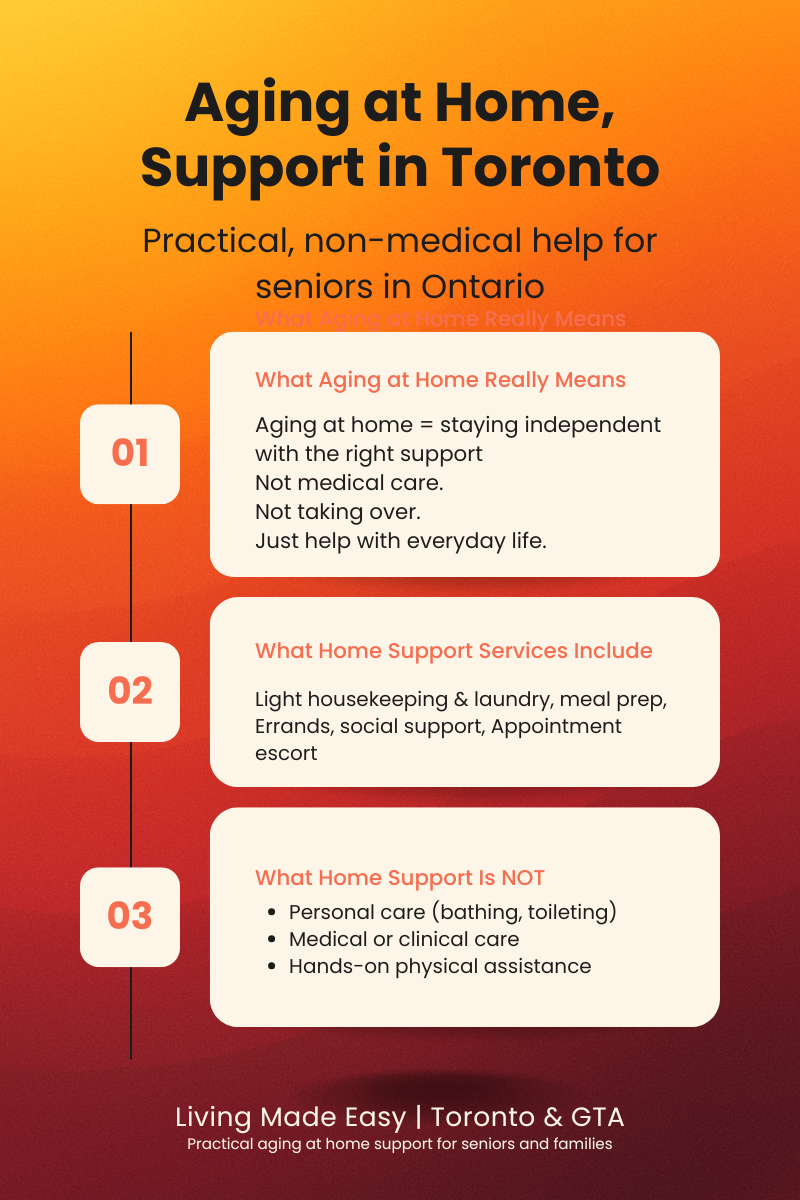
Home support services focus on everyday tasks that keep a household running. They are not about treatment. They are about the ordinary work of living.
Many non-medical home support providers typically help with tasks such as:
– Light housekeeping
– Laundry
– Simple meal prep and kitchen tidy
– Grocery shopping and errands
– Companionship
– Appointment escort, focused on logistics support
– Light organizing and decluttering
– Medication reminders
See what living made easy offer here
When these pieces are steady, it can reduce stress for seniors and for family members who live nearby or at a distance. It can also help avoid the cycle of catching up on chores, which can feel overwhelming and never-ending.
If you are exploring aging at home support Toronto, it can be useful to think of support as a weekly rhythm, not a one-time rescue.
Clear boundaries, what home support is, and what it is not
Clarity protects everyone. It helps seniors feel respected, and it helps families hire the right kind of help.
Home support is generally well-suited for household tasks, companionship, and practical planning support. It may also include simple prompting, like medication reminders, or keeping a shared list of needs for the next grocery run.
Personal care and medical services are a different category. If a senior needs clinical care or hands-on personal assistance, you will want to explore the appropriate regulated options in Ontario.
Keeping that boundary clear does not limit you. It actually opens the door to the right mix of supports. Many families use practical home support alongside other services, or as an early step before more complex needs arise.
Why small supports can make a big difference
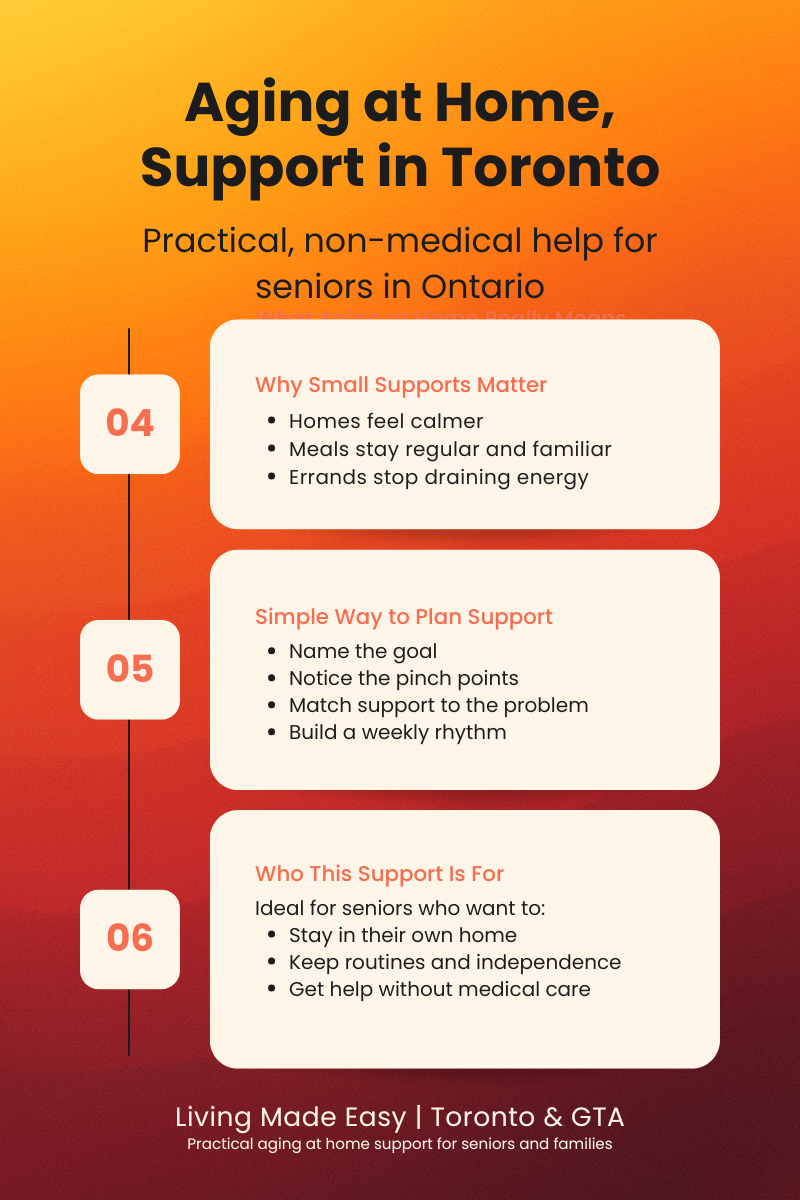
Many seniors do not want care. They want independence. Practical home support can align with that goal because it removes friction from daily life without taking over.
Here are a few common pressure points where non-medical support often helps:
1)Home feels harder to manage
Laundry piles up. The kitchen never quite resets. Mail and papers gather. None of it is dramatic, but it chips away at comfort and confidence.
Light housekeeping and light organizing can bring the home back to a steady baseline. That baseline matters. It is easier to eat well, sleep well, and feel grounded when your surroundings feel under control.
2) Meals become inconsistent
Eating can become more complicated with age, not because of one big issue, but because of decision fatigue and effort. Planning, shopping, prepping, and cleaning can feel like a lot.
Simple meal prep plus a kitchen tidy can help keep things easy and familiar, without changing someone’s preferences.
3) Errands start to feel draining
Grocery trips, picking up basics, and small household errands can become tiring. For adult children, running these errands can become a second job.
Grocery shopping and errands support can keep the week moving smoothly, especially when paired with a shared list that everyone can see.
4) Days get quieter
Even independent seniors can feel isolated, especially after retirement, driving less, or losing a spouse. Companionship is not about filling every minute. It is about steady human connection and a sense of being seen.
For families, companionship can also be a gentle way to keep a pulse on how things are going, without constant check-ins that feel intrusive.
A practical way to plan, start with values, then build a routine
Before you hire anyone, it helps to define what “a good week” looks like. This keeps the plan centred on the senior, not just on tasks.
Step 1: Name the goal in plain language
Examples:
– Keep the home tidy enough that it feels relaxing.
– Make sure there are easy meals ready.
– Reduce the number of errands my dad has to do.
– Add a bit more social connection to the week.
Step 2: Notice the pinch points
Look for repeated patterns:
– Are weekends spent catching up on chores?
– Are there skipped meals because the kitchen is messy?
– Is there stress around appointments and getting out the door?
– Is there a growing sense of loneliness?
Step 3: Choose support that matches the pinch point
If clutter is the issue, start with light organizing and decluttering. If the issue is daily rhythm, pair companionship with a kitchen reset and laundry.
Step 4: Keep it small and review
Many families do best when they start with one or two supports and then adjust. The goal is not to “do everything.” The goal is to make the week feel manageable.
A short checklist to guide your first plan
– Identify 2 to 3 tasks that cause the most stress each week
– Decide what “done” looks like for each task
– Agree on a simple schedule that fits existing routines
– Keep one shared list for groceries, errands, and household needs
– Set a check-in point after a few weeks to adjust the plan
This kind of planning is especially helpful when siblings share responsibilities. It turns vague concern into a clear, respectful plan.
Talking about help with a parent, without conflict
Even when help is clearly needed, it can be hard to accept. A parent may hear “support” as “loss of independence.”
A calmer approach is to keep the focus on comfort and choice.
Use practical language
Instead of “You need help,” try:
– “Let’s make the week easier.”
– “Would it be nice if the kitchen was reset after lunch?”
– “What errands would you rather not deal with?”
Offer options, not ultimatums
Choice preserves dignity. Ask which tasks they would happily hand off, and which tasks they want to keep.
Start with a low-stakes win
Many people accept light housekeeping or grocery support more easily than anything that feels personal. Once trust builds, other supports can be added if wanted.
If you are an adult child coordinating from a distance, consistency matters even more. A steady routine often works better than last-minute scrambling.
Building a sustainable routine, what to document
Aging at home goes more smoothly when information is simple and written down. Nothing elaborate. Just enough so that support is consistent.
Consider keeping:
– A short household preferences list, like how laundry is sorted or what foods are always on hand
– A grocery staples list and preferred stores
– A simple weekly rhythm, like which day is best for errands
– Appointment details and logistics, if an escort is needed
This reduces misunderstandings and prevents the senior from having to repeat themselves.
For families seeking aging at home support Toronto, this kind of documentation can also reduce stress when multiple people share coordination.
How Living Made Easy can help in Toronto/GTA
Living Made Easy provides non-medical home support services for seniors and families in Toronto and the GTA. Support is focused on everyday household needs and practical help that can make aging at home feel more manageable.
Services include light housekeeping, laundry, simple meal prep plus kitchen tidy, grocery shopping and errands, companionship, appointment escort for logistics support, light organizing and decluttering, and medication reminders, reminders only.
If you are researching options online, you may also see the name LivingMadeEasy. The focus is the same, calm, practical in-home support that helps keep daily life running smoothly.
When to reassess your plan
Aging at home is not one decision. It is a series of small adjustments.
It may be time to reassess if:
– The home starts to feel harder to keep up with, even with effort
– The senior is more tired by everyday tasks
– Family conflict increases around responsibilities
– Appointments and errands feel stressful to coordinate
– Loneliness is becoming a regular theme
Reassessing does not mean something is wrong. It means you are paying attention.
If you are comparing providers, ask clear, practical questions. What tasks are included? How are schedules set? How is communication handled? What is the process for changing the plan?
A steady approach helps people stay themselves
Aging at home in Ontario can be a dignified, realistic option when support is thoughtful and well-matched to real needs. The goal is not to take over someone’s life. It is to reduce friction, keep routines steady, and protect time and energy for the parts of life that matter.
For many families, aging at home support Toronto is less about a single service and more about building a dependable weekly rhythm, with help for the tasks that quietly weigh people down.
If you’re in the GTA and want to talk through what kind of in-home support might help you or your family, you’re welcome to reach out. Fill out the contact form below, and we’ll follow up with a short, friendly call, no pressure, just a conversation.
FAQs:
Q1: What are home support services for seniors (non-medical)?
Home support services help with everyday tasks like light housekeeping, laundry, simple meal prep plus kitchen tidy, errands, companionship, and light organizing. They do not replace medical or personal care.
Q2: How do I know what kind of support to start with?
Start with the tasks that cause the most weekly stress, then build a simple routine. Many families begin with light housekeeping and groceries, then adjust as needed.
Q3: Can home support include medication help?
Some providers offer medication reminders only. This is usually simple prompting, not handling or administering medication.
Q4: What is an appointment escort (logistics support)?
An appointment escort focuses on practical coordination, such as getting to and from an appointment and helping with timing and steps in the outing.